PennHIP and OFA Evaluations: What They Are, Why They Matter, and How We Offer Them at PVAH
PennHIP and OFA Evaluations: What They Are, Why They Matter, and How We Offer Them at PVAH
If you’ve ever talked with a breeder, trainer, or fellow dog owner about joint health, you’ve probably heard the terms PennHIP and OFA come up. They tend to sound a bit intimidating at first—very official, very acronym-heavy—but at their core, both are simply tools to help us understand a dog’s orthopedic health more clearly.
Think of them as different lenses looking at the same picture.
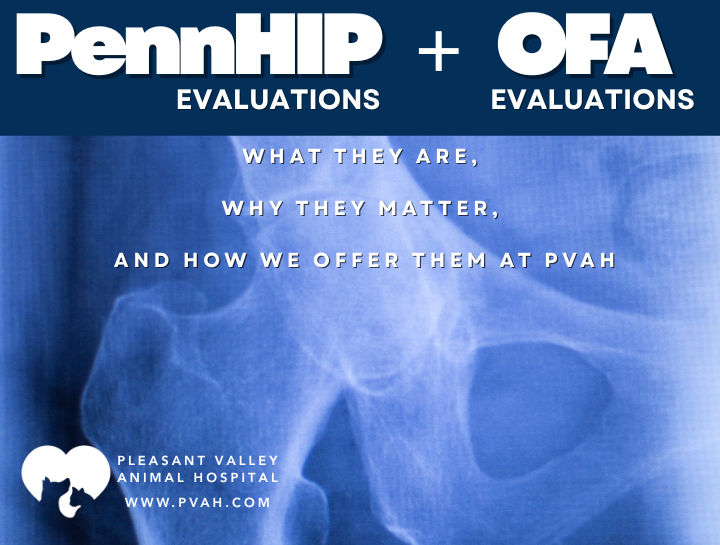
OFA (Orthopedic Foundation for Animals) evaluations have been around for decades. They’re typically performed once a dog reaches skeletal maturity (usually around two years of age) and involve taking X-rays of the hips (and sometimes elbows) to look for signs of dysplasia or degenerative changes. Those images are reviewed by a panel of veterinary radiologists, and the results are recorded in a public database. Many breeders rely on OFA results when making breeding decisions, and for good reason—it’s a well-established, standardized system.
PennHIP, on the other hand, focuses more on prediction. Instead of waiting to see if arthritis develops later in life, PennHIP measures how loose or tight the hip joint is, often at a much younger age (as early as 16 weeks). This is done by calculating a distraction index, which sounds technical but really just answers a practical question: How likely is this dog to develop hip problems down the road? It’s especially valuable for breeders who want to make data-driven decisions early, but it can also be helpful for owners who want to plan ahead for their dog’s long-term care.
A common question we hear is: “Is one better than the other?”
Not really—they serve slightly different purposes. OFA looks at how the hips appear, while PennHIP looks at how the hips function. Many breeders actually use both, and that combination can provide a very complete picture.
Another question: “Does my dog need this if I’m not breeding?”
Sometimes, yes. Knowing a dog’s hip status early can influence nutrition, exercise recommendations, weight management, and even training choices. Information is rarely a bad thing—especially when it comes to preventing pain later in life.
At Pleasant Valley Animal Hospital, we offer both PennHIP and OFA evaluations. Dr. Uranko is PennHIP-certified, which is an important distinction—PennHIP requires specific training and certification to perform correctly. These evaluations are done under sedation to ensure accuracy and comfort, and we’re always happy to talk through what to expect beforehand (no surprises, no mystery steps).
If you’re curious whether PennHIP, OFA, or both make sense for your dog, we’re always glad to talk it through. Sometimes it’s a five-minute conversation. Sometimes it’s longer. Either way, we’ll meet you where you are—coffee optional, thoughtful questions encouraged.